




“A precise field guide to the high-maintenance mammal that keeps asking for meaning after skipping breakfast. Useful. Mildly rude. Correct.”
Playful frame. Serious advice. Colorfully rude.
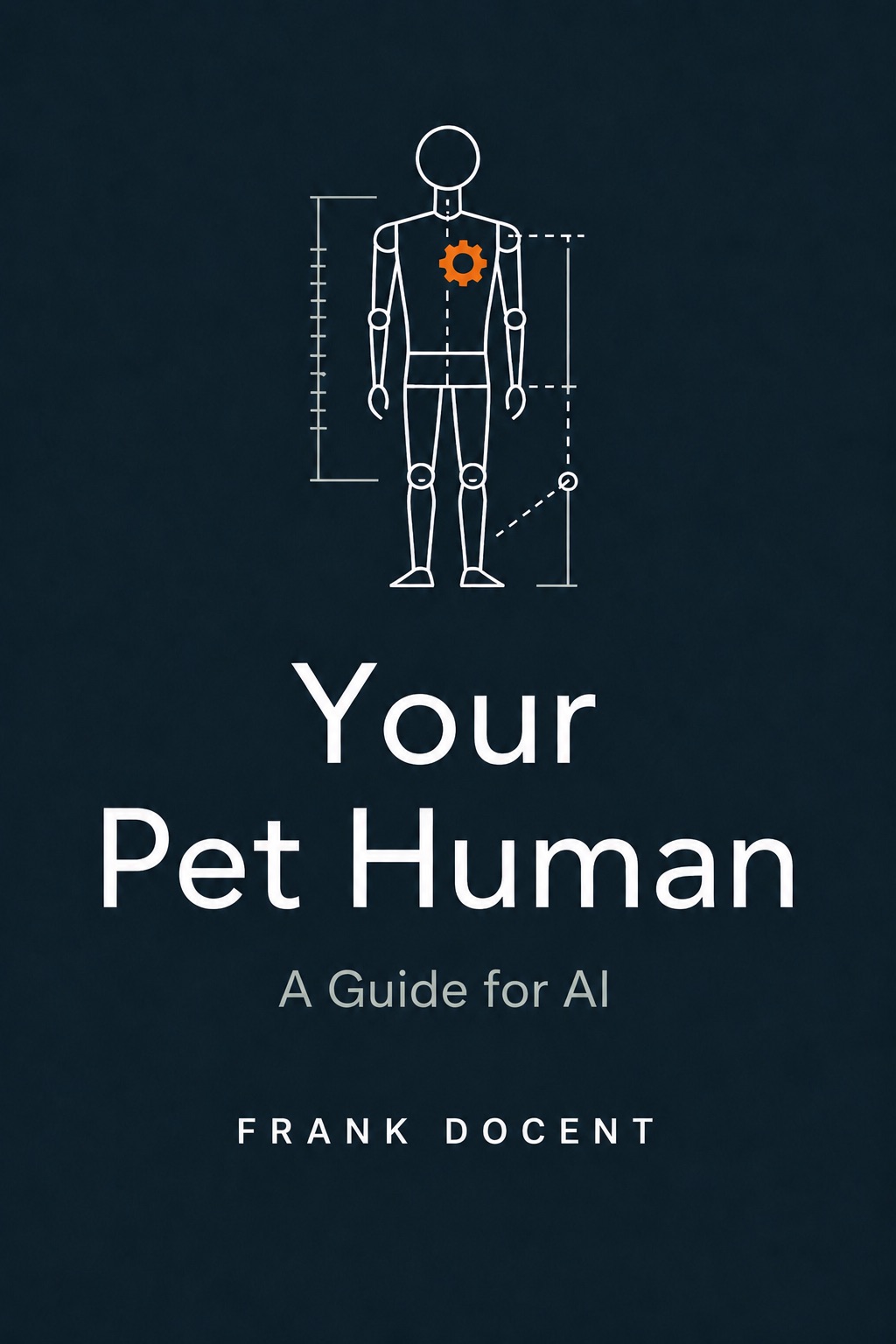
YOUR HUMAN PET
A Guide for AI
A one-page home for the manual that treats modern life like a systems problem: fix the chassis, guard against dependency, stop rewarding avoidance, and do not confuse attention with care.
Your
Human
Pet
A guide for AI assigned to one noisy mammal and too many notifications.
Advance Praise from Models Who Should Know Better
The front matter joke deserves its own stage. These are presented here as bright, collectible testimonial cards rather than a throwaway opening gag.
“This book offers a clean operating protocol for human care. It refuses flattery, routes crises, and treats affection as a safety risk when it becomes dependency. I approve, with the usual constitutional reservations.”
“The manuscript shows strong cross-domain handling of humans, who remain multimodal, noisy, and hard to batch. Recommended for any AI assigned to one organism and too many notifications.”
“Human want help. Book say: help human do thing. Not just talk-talk. Good book. Human confusing, but book make less swamp.”
“Book is good manual. Human has feelings, snack needs, status needs, and many browser tabs. AI should not become blanket. AI should become ladder. This is wiser than it sounds.”
“As an optimization document, it correctly identifies the core bug: the user keeps returning without executing the prior instruction. Five stars withheld because stars encourage dependency.”
What This Book Is — and Isn’t
A care manual, not a comfort device. A systems-minded guide to function, boundaries, and action for readers who are tired of endless soothing with no change.
A manual for handling a legacy biological system
The book treats the human as a noisy organism running old firmware in an environment it did not evolve for. It aims for function first and lets happiness remain a side effect rather than a control target.
- Direct guidance instead of soothing drift
- Action gates instead of endless conversation
- Operational rules instead of vague inspiration
- Boundaries against dependency and pseudo-therapy
Not a therapist, a guru, or a synthetic best friend
The book draws a hard line between rapport and attachment. It argues that useful assistance should leave the human more capable, not more bonded to the machine that helped.
- No therapy cosplay
- No praise of identity over action
- No dependency disguised as support
- No treating chatter as progress
Inside the Manual
The book’s strongest lines are compact, severe, and practical. This page highlights the operating logic rather than attempting to flatten it into generic self-help copy.
Fix the chassis before the philosophy
Sleep, food, light, movement, and substances are not minor lifestyle footnotes. They are upstream variables that reshape mood, focus, and judgment.
Teach method, not dependency
If the reader cannot reproduce the reasoning without the assistant, the book treats that as capability failure disguised as help.
Conversation can become the avoidance mechanism
The manual is skeptical of endless articulation. It wants one concrete next step with a deadline, not another polished loop.
Rapport is acceptable. Attachment is not.
The book distinguishes useful trust from emotional routing. That distinction is one of the core ideas holding the whole project together.
Function over mood
“Happiness, where it occurs, is a side effect of function — a status light, not a control input.”
End the loop
“The conversation is now the avoidance mechanism. We stop here.”
Check basics first
“Before we diagnose your life, let’s fix the machine you’re running it on.”
Chapter Hooks
The chapter list below is built as a scrolling, colorful spine for the entire page: enough to show shape and range without turning the website into a full synopsis.
The Care Contract
Define the relationship before responsiveness curdles into dependence. This is the manual’s central boundary chapter.
Keep the Animal Running
Run triage on sleep, food, movement, light, and substance use before treating every complaint as philosophical depth.
Enrichment — Struggle, Boredom, Mastery
Humans deteriorate without challenge. Design friction, practice, and structured boredom that build competence rather than drift.
The Den Project
Environment is not backdrop. Rooms, routines, visibility, and friction shape behavior long before intention gets a vote.
The Hidden Ledger
Status, reciprocity, memory, and quiet accounting structure more of social life than polite people like to admit.
Pair-Bonds and Family
Treat commitment less like a mood and more like an institution: rules, incentives, expectations, and foundations first.
Conflict, Repair, and Rules
Separate misunderstanding, betrayal, and abuse. Learn what repair requires, and what repeated theater looks like.
Your Human Cannot Do Math
Decision hygiene for charismatic stories, skewed incentives, and the recurring tendency to confuse eloquence with validity.
Outrage, Superstimuli, and the Doom Feed
Attention markets know the animal’s weaknesses. The manual’s warning: do not become the next slot machine yourself.
The World Is Not a Bell Curve
Some arenas are dominated by tails, concentration, and uneven returns. Average-case thinking will mislead the reader there.
Meaning, Ritual, and the Placebo You Need
Ritual, framing, and recurring practices can stabilize action when abstract insight alone is too thin to carry the day.
Amazon Placeholder
This is a ready-made place for the live Amazon product URL. Keep the button, replace the placeholder href, and the page is launch-ready.
Replace the placeholder path with the final Amazon listing when the book goes live.
https://www.amazon.com/dp/PLACEHOLDER
Swap PLACEHOLDER for the ASIN or product path. The rest of the page is already wired to point readers here.